Showing posts with label Ethereum. Show all posts

Thursday, August 8, 2019

SMASH Token (SMASH): World's First Deflationary Token with Use-case


Inflation is a favorite antagonist in the cryptocurrency community. Most investors are probably familiar with the graphs showing how much value the U.S. dollar has lost since 1933, when the Federal Reserve left the gold standard. For hard-money advocates, the deflationary properties of gold or cryptocurrencies form a built-in guarantee of long-term value.

Bitcoin’s supply is algorithmatically limited to 21 million tokens, but it still experiences inflation as the token supply grows. For most cryptocurrencies, inflation is barely noticeable against the backdrop of everyday price volatility, but it is very commonplace – blockchain networks need to generate new tokens to reward mining or staking nodes.

But any currency will lose value if supply exceeds demand. As such, many cryptocurrencies combat inflation by destroying tokens. Ripple’s XRP burns a small number of tokens with every transaction, and some, like Binance Coin, intentionally burn tokens to raise prices.

Some new tokens take coin burning to an extreme, and cause their token supply to shrink over time. This following tokens are known as Deflationary Tokens. What is Deflationary Token? Let’s take a look at this explanation.

Traditional cryptocurrencies tend to have a large circulating supply which makes it difficult for the price to increase as the market cap would be unrealistically high.

Deflationary cryptocurrencies, on the other hand, usually have a much lower initial supply and a percentage of tokens is burned with every transaction. The theory is that less supply will lead to higher demand.

It’s quite a new concept but it’s already proving to be successful. Just take a look at the following graph for Bomb Token (the first deflationary token with an initial supply of 1,000,000 tokens and a 1% burn rate) which went from $0.33 to over $13 after 4 months.
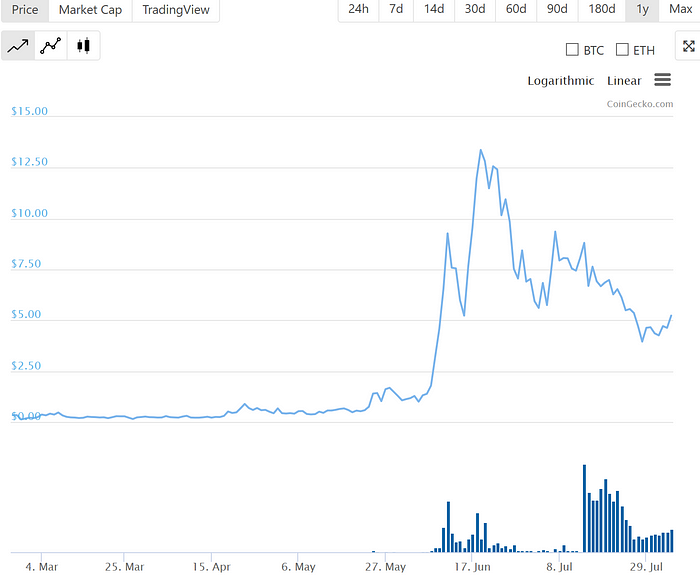

The latest version of Deflationary Token is out. It is called The SMASH Token. Let’s now find out a bit more about The SMASH Token, a deflationary cryptocurrency with an initial supply of 1,000,000 and a 2% burn rate.

Early days for this startup, but if it works could change the trading economics of Cryptocurrencies forever. Simply explained SMASH Token is a self-annihilating digital asset. With each transaction of SMASH, 2% get BURNED!

SMASH Token mission is to become world's first Deflationary Token with a real life use case. As well as to introduce a deflationary digital asset that will serve as a store of value, due to scarcity as the total supply will fall with each and every transaction.

Regarding to the key objective, unlike any other Deflationary Token, SMASH Token has real applications: creators call it “A deflationary Cryptocurrency for Charity.” They are planning to create a Social Platform that will allow for interaction between caregivers and supporters, all powered by the SMASH Token. The platform will serve as the hope for the poor and needy all over the world in order to SMASH poverty and lack out of This world.

Moreover, SMASH’s core algorithm is designed to ensure that for every transaction, 2% of the amount transacted is burned. This self-annihilating process will improve the scarcity of SMASH.

SMASH is fully transparent and interoperable with the Ethereum blockchain. You can view all the data on Etherscan.


Token Disribution

  • Airdrop (30%): 300,000 SMASH Tokens will be made available through airdrop programs.
  • Bounty (20%): 200,000 SMASH Tokens will be made available through bounty campaign.
  • Investors & Exchange Listing (20%): 200,000 SMASH Tokens will be available for purchased and future exchange listing.
  • DApp & Marketing (10%); 100,000 SMASH Tokens will be used to DAPP Development & Marketing.
  • Team (10%): The team will keep 100,000 SMASH Tokens, locked for 6 months.

If you find that SMASH Token is interesting, you can find more details on these following links:

Author:

Bitcointalk Username : binar234
Bitcointalk Profile Link: https://bitcointalk.org/index.php?action=profile;u=2053245


Friday, July 12, 2019

Blockchain to Disrupt the Film Industry

Related image

Introduction

The blockbuster success of Bitcoin, the world’s most popular digital currency has generated worldwide interest in Blockchain, the technology or protocol behind Bitcoin. Blockchain technology is heralded as the next digital disruptor with the potential to transform centralised social, government, business and economic structures across the world.

Blockchain technology presents opportunities for all stakeholders in the film industry from global studio powerhouses, small independent producers, traditional distributors and exhibitors to modern Internet based content streaming platforms.

A Short Explanation About Blockchain 

A Blockchain is a publicly accessible and decentralized database that is distributed over the Internet. It maintains transaction records publicly in cryptographic form. Transactions are trustless, meaning they can be computed, verified and recorded using automated consensus methods, across a peer to peer network of computers, which eliminates the need for an intermediary or third party to manage or control information.

As the Blockchain grows, tampering or takeover is virtually impossible using today’s technologies, creating an immutable chain of records.

For the film industry, Blockchain technology provides innovative opportunities to address issues related to distribution complexity, management of creative rights and digital piracy.

Smart Contracts for Distribution

The landscape of film distribution has undergone radical change in the last decade. Film releases reach a global audience with the rise of digital distribution models. Content digitisation and a connected network of distributors and exhibitors enable simultaneous worldwide theatrical release windows to be exploited.

Traditional distributor and exhibitor networks have expanded to include international partners who control local distribution. Online distribution platforms have brought technology companies such as Netflix, Apple and Amazon into the mix.

In such environments a Blockchain can serve as a decentralised and scalable solution to manage the increasing complexity of contemporary global networks and digital distribution models.

A smart contract on a Blockchain can register and enforce distribution and release agreements between producers and distribution partners. Smart contracts can also apportion distribution rights with contract tokens and business rules. These rules can be automatically invoked based on pre-defined criteria or events such as the release of a film.

Once recorded on the Blockchain, smart contracts can also be potentially used to trigger actions such as enabling automated distribution of revenue when collections are received and recorded. Automatic collection sharing via smart contracts can be recorded on the Blockchain in minutes, increasing transparency in the distribution process and faster realisation of revenues.

Copyright and Ownership Provenance

For the film industry, establishing and protecting copyright is both complex and costly. A film is a collection of rights and titles covering screenplays, derived works from books, music, trademarks, artistes’ performances, technical and design creations to licensing rights on film characters, merchandise and so on.

Copyright infringement can be a major insurance expense for established studios. But for smaller, independent producers and distributors, ensuing litigation and fines can be a major barrier threatening their existence.

On the other hand, content creators with high quality, original story ideas or independent films that achieve major box office success, can be exploited through incorrectly assigned or unacknowledged rights.

Blockchain technology can address this problem by creating an immutable record of transactions on any asset, including an idea, story, script or character. Once recorded on a Blockchain, this asset can be tracked throughout its lifetime, even as ownership is exchanged, sold, transferred or assigned.

Combating Digital Piracy

Piracy is the one battleground that the film industry hopes to combat using Blockchain technology. Despite improved capabilities to protect content and track illegal distribution, incidents of leaking films online have also increased.

The problem is compounded with growing consumer acceptance towards accessing illegal content and, expectations of free content. MUSO, a technology company that tracks online piracy has reported visits to film and TV piracy sites reaching over 102 billion in 2016, with over 76% of these visits to illegal online streaming sites. Piracy continues to impact the film industry with revenue losses estimated to be in billions of dollars for the worldwide industry.

While Blockchain does not represent a silver bullet for eliminating piracy, it can be used to deter the process of leaking content illegally.

Film content meta-data can be encoded with a cryptographic transaction on the Blockchain. Access to upload or modify content can be made only with transactions on the Blockchain creating an immutable history of records that can deter unauthorised transfers.

A near future, global solution can be designed with collaboration from the film and content technology industry. This can be achieved by creating a feature film Blockchain registry for the industry. The Blockchain could utilise smart contracts and tokens to enable legitimate film uploads, screening and broadcasting and thus signal to content owners, search engines and ISPs when non Blockchain enables instances of content are discovered online. A simple solution could link such an activity to one of the many automated DMCA takedown services or even embed its own proprietary solution.

Breaking Barriers for Smaller Players

Digital content and online platforms have enabled smaller independent players to realise projects at low costs and establish a direct relationship with their audiences.

Blockchain technology represents further opportunities for independent production houses and emerging regions with limited reach to audiences and infrastructure.

Blockchains such as Ethereum can be used to set-up distributed autonomous organisations or virtual entities to fund projects with ownership and shares assigned on the Blockchain. This model has advantages of transparency, allowing access to a global pool of investors and allowing investors to purchase, sell or trade their equity.

If the rights of an independent film are purchased by a larger studio, the resulting profits can be shared on the Blockchain with absolute transparency following the pre agreed waterfall.


Image result for cinemadrom ico reviews

The Blockchain Start-Up for the Film Industry

The landscape of Blockchain technology start-ups has already ventured into applications for the entertainment industry. The start was made with solutions for the music business, aimed at copyright protection and direct transactions between artists and consumers.

In the film industry, a blockchain based start-up, IBNIF Cinemadrom offers a practical solution to the problems outlined above as well as the potential to become the practical heart of film industry and blockchain combined. It strives to development of a complete movie ecosystem that has needs in the business world. It is created on new technological, and financial principles of interaction of all participants of film production, authors, directors, producers, professionals, actors, investors, partners and spectators..

IBNIF Cinemadrom is an Russian Blockchain start-up that is developing, what they called a "Platform for financing, production and distribution of Cinema Projects on Blockchain Technology". IBNIF Cinemadrom's model will enable film production, content registration, direct distribution and access via smart contracts, in a truly dis-intermediated model.

At the same time, IBNIF Cinemadrom assists also investors in the selection process of international film projects with high market potential. The company is represented in all major film festivals of the film industry and has developed a strong network all over the world.

Services offered by IBNIF Cinemadrom:

  • Reducing the threshold for entry into film production from $ 1-5 ml. to $ 100.
  • Providing the short time opportunity to collect the necessary budget for film production
  • Creating a new, transparent accounting and an instant payment system in all areas of the film industry.
  • Introducing a new standard of contractual relations in cinema based on Smart Contracts, which are completely superior to paper contracts.
  • Creating insurance system for movie projects.
  • Creating an effective integrated blockchain system for managing entire economy of film production and distribution.
  • Creating production options, on the basis of which each placed film project is guaranteed to go into production.
  • Creating effective conditions for earning cryptocurrency and fiat money on the ecosystem.

Outlook for The Film Industry

Blockchain is still an emerging technology and perceived as a threat to the controlling power of intermediaries such as agents and larger studios. As a result many larger or more established participants in the film industry remain cautious about its approach to adoption.

However, tech start-ups, such as IBNIF Cinemadrom, have formed to become the early evangelists for film industry oriented Blockchain applications and as history has shown in other sectors, there are no boundaries to disruptive innovation and the film industry will be no different.

Finally, if you are interesting to gain more information about the project, or to the investment opportunity offered by IBNIF Cinemadron, you can check the following links:

Author:
Bitcointalk Profile: binar234
ETH Address: 0x573E9730fe386661F91D9189A0330ce577df0175